Materials
Plastic Toy Maker
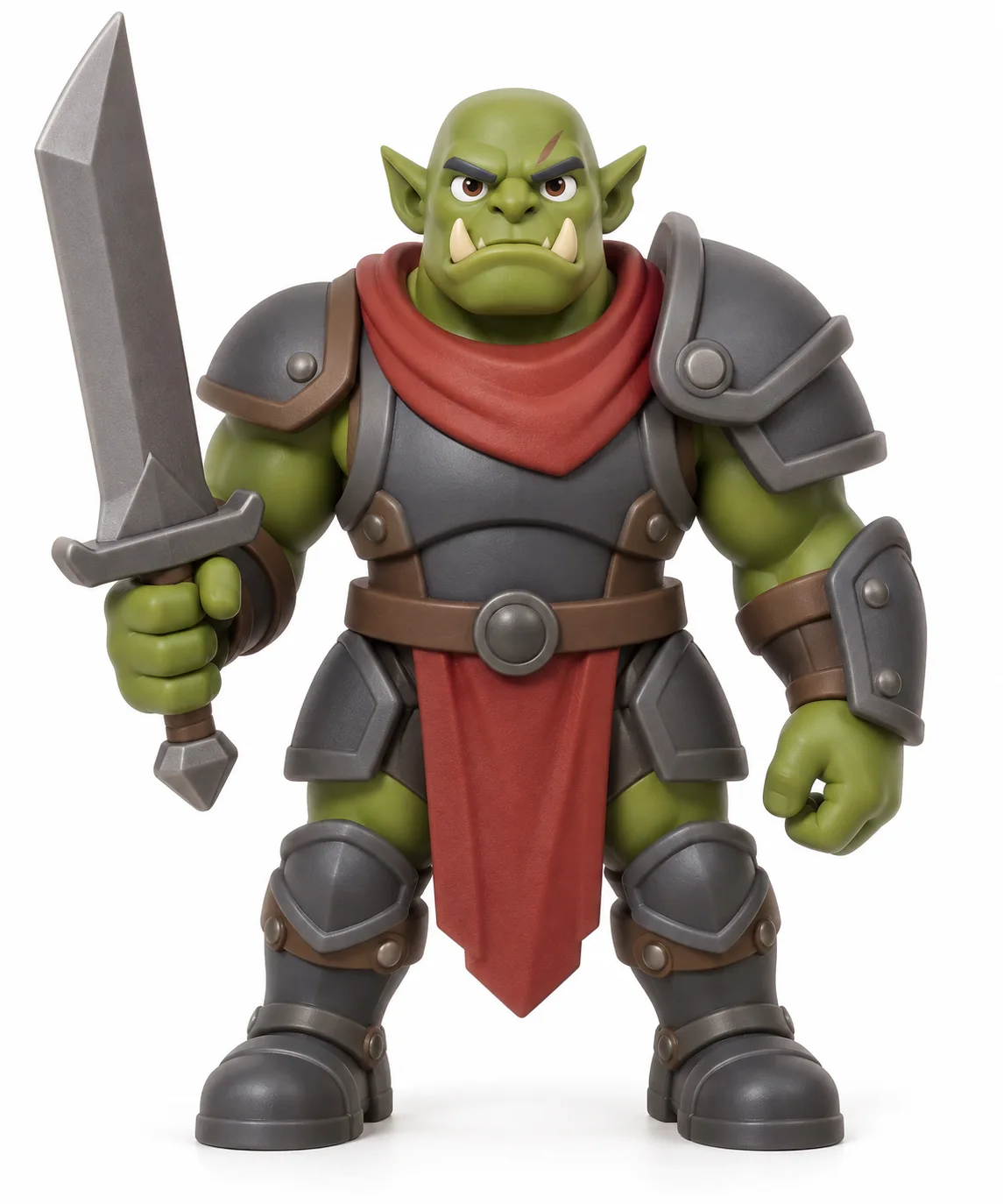
`Create an ultra-realistic articulated collectible toy figure based on the theme [Astronaut with purple elements]. Invent an original design that clearly communicates the chosen theme while remaining visually simple, iconic, and toy-like. The figure must look like a real physical premium toy photographed in a professional studio, not like CGI, not like a digital character render, and not like a real human or animal.` `Use stylized cartoon-like toy proportions: slightly oversized head, simplified body masses, slightly exaggerated hands, feet, paws, or signature features where appropriate, and a clean readable silhouette. The shapes should feel intentionally sculpted for a toy, with softened simplified anatomy rather than true-to-life proportions.` `Keep the sculpt clean and simplified, with only essential toy details. Avoid excessive micro-detail, dense panel lines, tiny technical elements, realistic skin or fur simulation, and overly complex surface noise. Use broad molded forms, clean separations, and a premium collectible-toy design language.` `Make the toy from dense high-quality injection-molded ABS and PVC plastic. The surface must look like real premium plastic with believable solid thickness, subtle micro-texture, clean molded edges, slight parting lines, fine seam separation, soft satin-to-semi-gloss reflections, and small realistic manufacturing imperfections. Avoid overly shiny CGI plastic and synthetic render perfection.` `Include clean functional articulation at natural toy joint locations. Use believable ball joints, swivel joints, hinge joints, sockets, pivots, and overlapping molded parts. Keep the articulation subtle, sturdy, and mechanically plausible. Do not randomly divide the figure into too many pieces.` `Single standalone toy only. The entire toy must be fully visible and centered, isolated on a pure solid white background. No display stand, no pedestal, no base, no box, no packaging, no blister pack, no environment, no scenery, no text, no watermark, no extra objects.` `Camera angle is strictly limited to only two options: FRONT VIEW or FULL SIDE PROFILE.` `Use a completely front-facing view for upright, compact, humanoid, vertical, or naturally front-readable subjects. The camera must be centered and perpendicular to the toy, with the body facing straight toward the camera.` `Use a true full side profile only for long-bodied or horizontally oriented subjects such as jaguars, elephants, crocodiles, horses, dogs, cats, or similar animals. The entire body, head, legs, and tail must be viewed from exactly 90 degrees from the side.` `Do not use three-quarter views, diagonal angles, rotated poses, dynamic perspectives, high-angle views, low-angle views, foreshortening, or perspective-heavy composition. No visible second side of the face or body in side-profile mode. No asymmetrical camera rotation.` `Use a neutral orthographic-like product photography feel with minimal perspective distortion. Camera at the toy's mid-height, medium telephoto product lens, full object visible, generous white margin around the silhouette, no crop.` `Make it look like a real commercial studio photograph of a physical mass-produced toy: soft neutral studio lighting, realistic exposure, sharp focus, subtle contact shadow directly beneath the toy, realistic plastic behavior, and small believable manufacturing imperfections.` `The final result must look like a real premium articulated toy photographed in a catalog studio, with stylized toy proportions, simplified realistic detailing, and one of only two clean presentation angles: exact front view or exact full side profil`
Free to copy, edit and use in your preferred AI image tool.